Development of a Plume Evolution Model for Launch Vehicle Ground Cloud Deposition
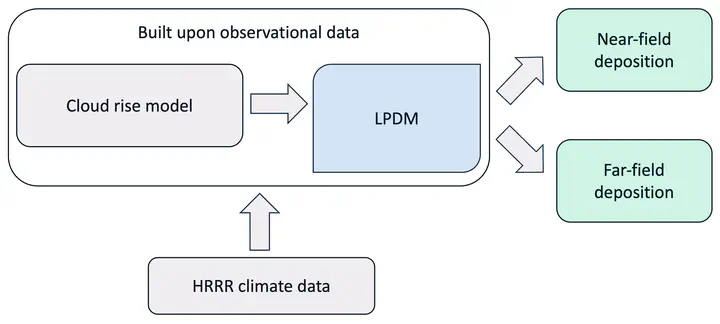
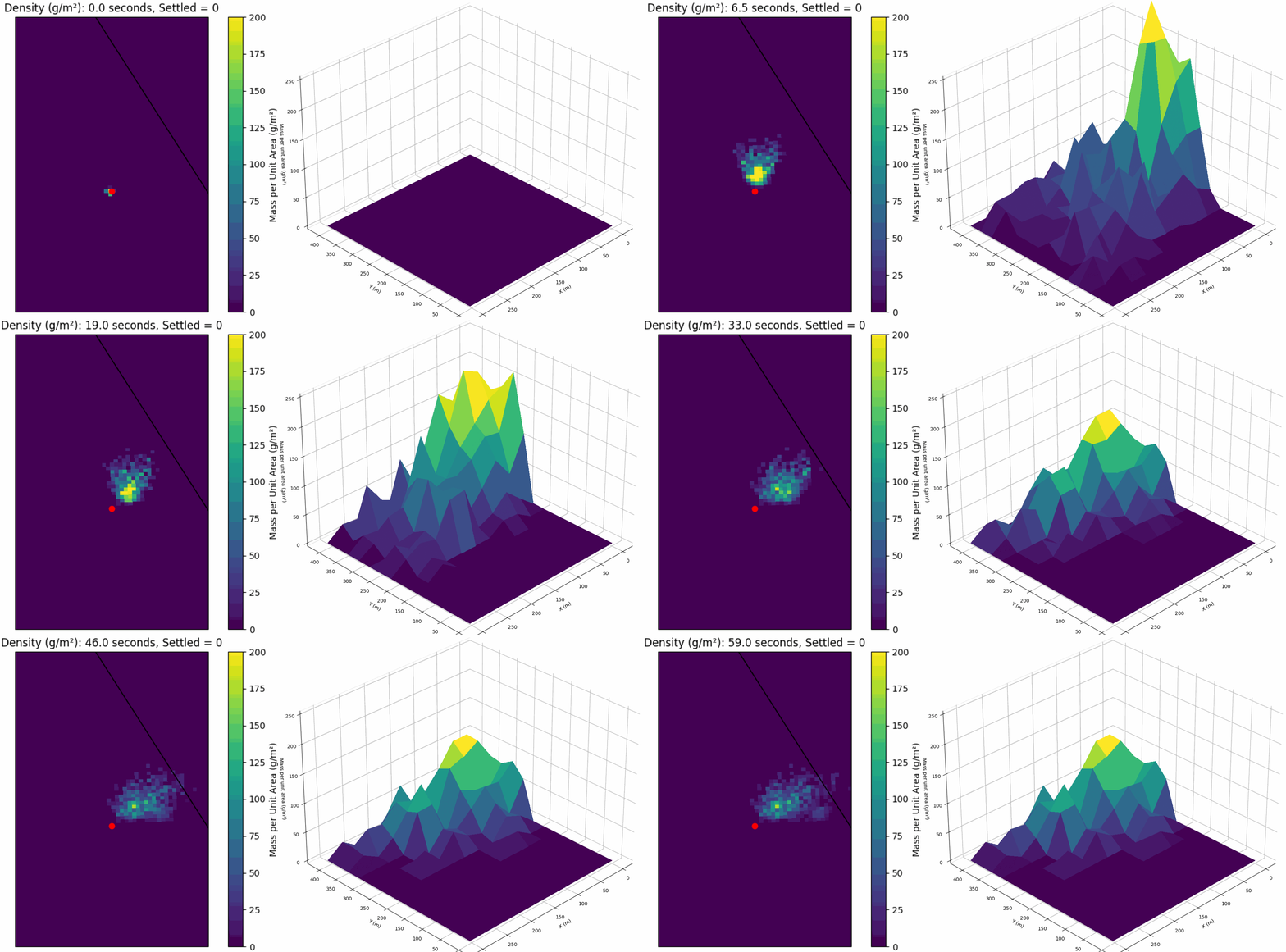
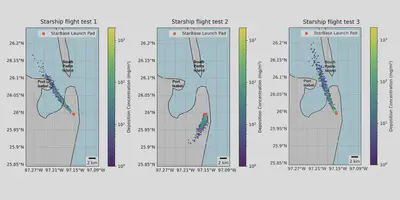
Solid rocket exhaust ground clouds contain high concentrations of toxic acidic compounds and particulate matter. Numerous efforts have been made to accurately predict their deposition; however, uncertainties increase substantially with varying atmospheric conditions. This study developed a plume evolution model to predict both near-field and far-field acidic deposition using a Lagrangian Particle Dispersion Model (LPDM) as the primary simulation framework. A dedicated cloud rise model was also developed to better capture the vertical evolution of rocket exhaust ground clouds, a critical factor influencing far-field deposition. The near-field, far-field, and cloud rise models were validated using observed data from recent studies. Our results demonstrated good agreement when compared with the observed data. The model was applied to the SpaceX Starship integrated flight test launches at the Starbase facility in Boca Chica, Texas. When combined with local wind statistics, the results indicate a significant potential for the ground cloud to reach nearby residential areas. Although Starship employs LOX/LCH₄ propellants, nitric oxide (NO) can form during the plume–air entrainment process, posing potential risks to human health.

Nattanan Wongprapinkul
PhD student and Graduate Research Assistant (co-advised)
Nattanan is a PhD student in the Aerospace Engineering department at the University of Michigan. His research interests include space infrastructure development, space system design, and trajectory optimization.