Dependence of Atmospheric and Climate Impacts on Launch Latitude and Seasonal Variation in Rocket Emissions
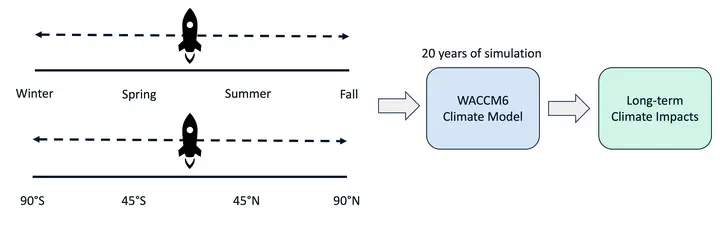
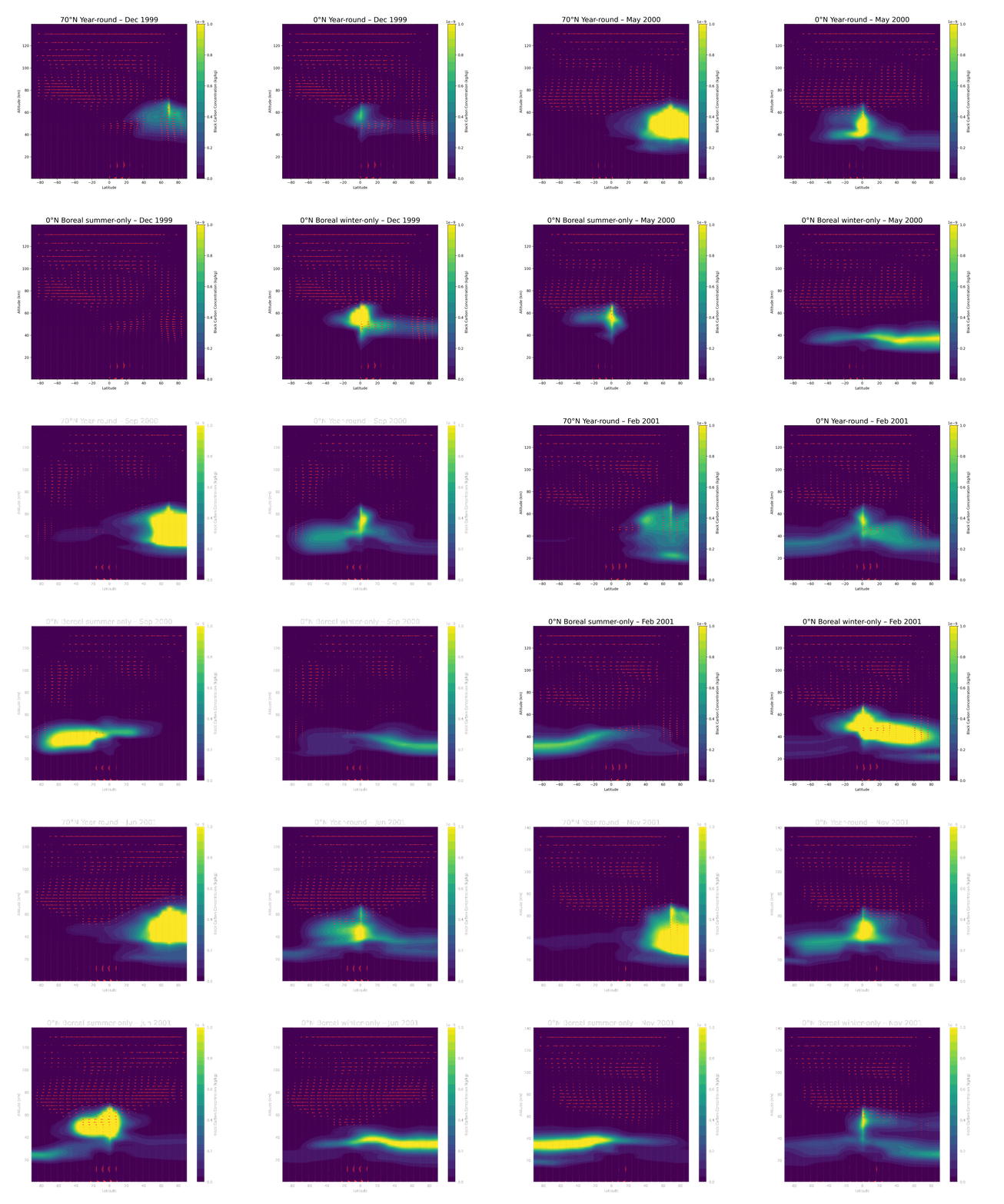
Rocket launch emissions, dominated by black carbon, H2O, and NOx, are known to contribute to changes in atmospheric composition that can influence Earth’s climate, particularly for the large annual launch rates expected in the future. This study investigates the latitudinal and seasonal dependencies of the atmospheric impacts of rocket launch activities, examining how the annual timing of launches influences long-term climate impacts such as stratospheric temperature changes, ozone loss, and Effective Radiative Forcings. In each case, we simulate 20 years of launches using WACCM6, with the same annual launch frequency. To examine latitudinal dependencies, launches are simulated from six latitudes (55° S, 29° S, 0° N, 29° N, 55° N, and 70° N). To assess seasonal dependencies, three scenarios are considered (boreal summer-only, boreal winter-only, and boreal year-round launches). In terms of global stratospheric temperature changes, Northern Hemisphere launches generally produce less warming. In contrast, more severe ozone losses are observed for launches from the Northern Hemisphere. Seasonal dependency becomes more pronounced for launches closer to the equator, where the strong tropical meridional winds reverse direction between seasons.
This work is in collaboration with Dr. Oliver Jia-Richards.

Nattanan Wongprapinkul
PhD student and Graduate Research Assistant (co-advised)
Nattanan is a PhD student in the Aerospace Engineering department at the University of Michigan. His research interests include space infrastructure development, space system design, and trajectory optimization.