Hybrid-Electric Aircraft Operations and Design Analysis
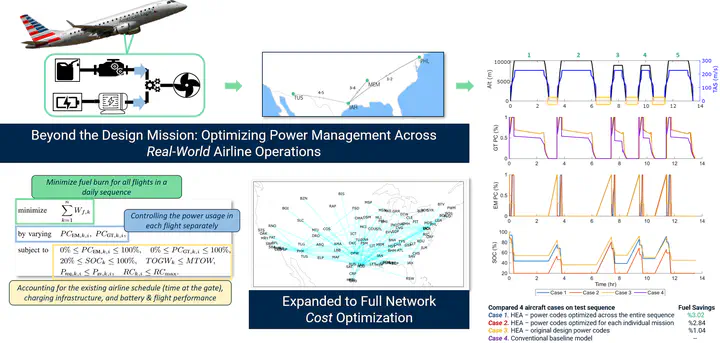
Hybrid-electric aircraft (HEA) design is highly dependent on the operational context in which the aircraft will be used. To be viable, new HEA concepts must not only reduce fuel burn and operating costs, but also remain compatible with the realities of today’s air traffic system. Our research considered new HEA designs specifically in the context of regional jet routes and their operational constraints.
Our core methodology focused on coupling early-stage aircraft design with detailed operational analysis. This integrated approach ensures that design decisions remain feasible when applied to real-world airline operations. To support this work, we compiled a large dataset of regional airline routes, capturing key mission values such as time at gate, cruise altitude, and mission range.
A central factor in HEA performance is the power management strategy—the split between the gas turbine and the electric during a mission. Hybrid-electric aircraft benefits are highly dependent on this strategy; without it, the additional weight of onboard batteries could increase fuel burn compared to conventional aircraft. Importantly, the optimal strategy is not defined solely by mission variables like range or altitude, but also by operational factors such as available charging time at the gate. We optimize the HEA power management strategy based on an aircraft’s full day of flights to consider mission and operations.
In further work with LATTICE, HEAs were incorporated into a full fleet assignment model representing a legacy U.S. carrier. Results showed that HEAs using optimized power management strategies were assigned to a significantly larger share of routes than those without, underscoring the importance of operation-based design and analysis.
Our findings demonstrate that operation-driven design is integral to making hybrid-electric aircraft practical and impactful. By aligning aircraft design with real operational environments, we can maximize the value of hybrid-electric systems and accelerate their adoption in commercial aviation.
This research on Hybrid-Electric Aircraft Operations was sponsored by RTX.

Emma Cassidy
PhD Student and Graduate Research Assistant
Emma is a PhD candidate in Aerospace Engineering at the University of Michigan and works as a Graduate Student Research Assistant in the IDEAS Lab. Her research interests are sustainable aviation, experimental aircraft design, and commercial aircraft operations.