Li-ion Battery Pack-level Design, Life-Cycle Prediction, and Cost Modeling
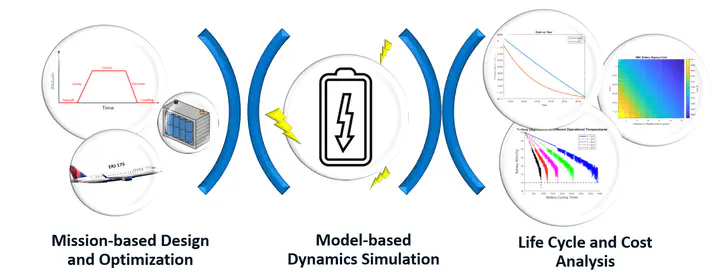
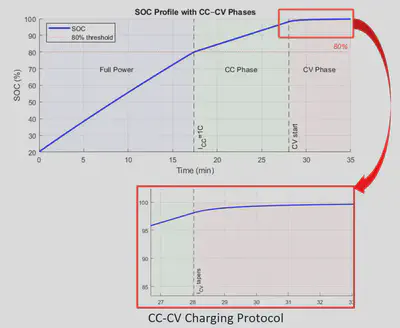
We developed a framework for lithium-ion battery pack-level design and optimization for aircraft propulsion energy sources. The framework includes the three main parts: (i) mission-profile-based design, where the battery power/energy required is derived from the physics performance analysis and aircraft architecture; (ii) model-based (an equivalent circuit model) dynamics simulation of the Li-ion battery cell, other components including Constant Current-Constant Voltage (CC–CV) charging protocol, sizing optimization based on battery C-rate and SOC constraints, and an empirical cycling aging model of NMC and LFP battery parameterized by stress factors such as Depth of Discharge (DoD), C-rate, temperature, Full Equivalent Cycles (FECs), and so on; and (iii) lifecycle analysis, simulating aircraft off-design for monitoring battery State-of-Health (SoH) trends and predicting End-of-Life (EoL) while cycling.
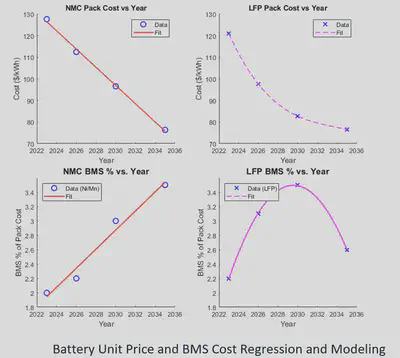
In addition to the battery’s physical/empirical models, we have a battery economic model, coupled with regressed NMC and LFP battery unit prices and Battery Management System (BMS) cost allocation trends. This function enables forward-looking predictions of battery replacement costs. The general concept would be presented as a trade study, for example, between the NMC and LFP chemistry battery performance degradation influence on aircraft performance, operation, and economics to achieve a techno-econ lifecycle study. Providing insights and thoughts on the progress of next-gen batteries in electric aviation.

Yipeng Liu
Research Assistant
Yipeng Liu is a research assistant at the IDEAS lab at U-M, working on the hybrid electric aircraft operations project.