Mission-level integration of HT-PEMFCs and LH2 tanks for a retrofitted parallel hybrid-electric aircraft
Abstract
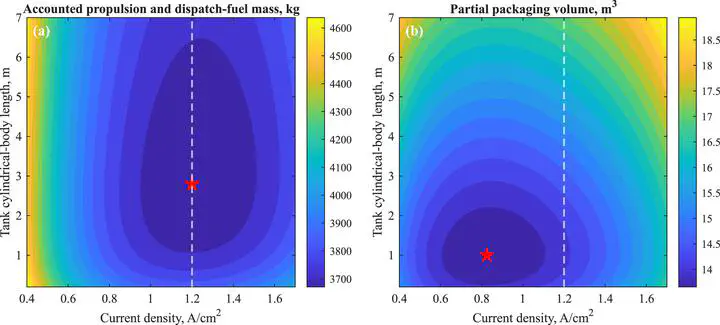
This study develops a harmonized Dash 8 Q300-class baseline in the Future Aircraft Sizing Tool (FAST) and evaluates a parallel hybrid-electric retrofit coupling high-temperature proton exchange membrane fuel cells (HT-PEMFCs), payload accounting, and layer-resolved liquid-hydrogen (LH2) tank pre-sizing for a 1518.64 km full-payload design mission. The HT-PEMFC model, calibrated against 413–473 K polarization data, uses a corrected PA-PBI conductivity relation. Increasing current density reduces installed cell count but lowers efficiency and raises hydrogen demand. At fixed hydrogen inventory, shorter tanks minimize volume, while longer tanks reduce liner mass but require more insulation. At 100% scheduled electric fraction with ideal fixed-current staging, minimum partial packaging volume is 13.66 m3 at 0.825 A/cm , whereas minimum accounted propulsion-and-dispatch-fuel mass is 3.67 t at 1.20 A/cm. Neither unconstrained optimum fits the 1.86 m cabin envelope; fixed-diameter cases retain 20–24 passengers at 100% scheduled electric fraction and 40–41 at 25%. The two optima remain separate across 512 engineering scenarios under fixed-current staging and coincide at 1.20 A/cm under full-area variable-current operation. At 0.035 W/(m K) foam conductivity, the 1.86 m tank-diameter constraint cannot be met within 20 m. Stack dispatch, tank insulation, cabin geometry, and hybridization level determine the preferred operating point.

Yi-Chih "Arenas" Wang
Research Associate
Arenas Wang is a research associate in the IDEAS Lab at the University of Michigan.